Top 10 Copper Part Machining Manufacturers Worldwide

Finding a dependable supplier for copper components requires more than comparing website claims. This guide introduces the Top 10 Copper Part Machining Manufacturers Worldwide, focusing on practical capabilities, engineering depth, and production consistency.

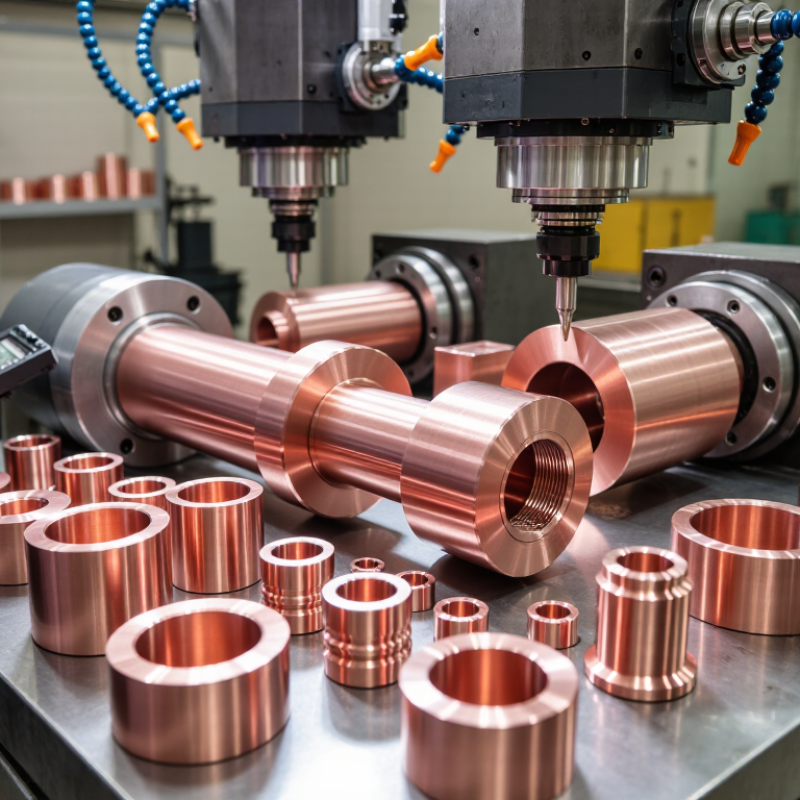
Copper is highly conductive, but it can smear, deform, and generate difficult chips during machining. Experienced manufacturers control cutting speeds, tooling geometry, coolant flow, and workholding pressure. Their results should show through clean threads, stable dimensions, smooth bores, and dependable surface finishes. Small details matter.

The manufacturers considered here serve industries such as electronics, power systems, automotive equipment, telecommunications, and industrial automation. Evaluation includes CNC capacity, tolerance control, inspection equipment, material traceability, prototype support, and high-volume production experience. Relevant certifications and documented quality procedures also strengthen supplier credibility.

However, no ranking can represent every buyer’s priorities. A company excellent at miniature connectors may not suit large busbars or complex copper assemblies. Public information can also be incomplete, outdated, or overly promotional. That weakness deserves attention. Buyers should request recent inspection reports, material certificates, sample parts, and realistic lead-time commitments before placing an order.

This overview is designed to support informed supplier research, not replace technical due diligence. Each Copper Part Machining project has different demands involving alloy selection, conductivity, tolerances, quantity, and delivery risk. Comparing these factors carefully can reveal the most suitable partner, even when the most famous manufacturer is not the best fit. Small trials help. Mistakes become expensive when verification begins too late.
Top 10 Copper Part Machining Manufacturers Worldwide

Copper Machining Fundamentals: 58 MS/m Conductivity and Key Material Grades

Copper machining begins with conductivity, not cutting speed. Commercially pure copper reaches about 58 MS/m, equivalent to 100% IACS at 20°C. This benchmark comes from the International Annealed Copper Standard and supports consistent electrical design comparisons. However, conductivity changes with purity, temperature, and processing history. Treat the figure as a reference, not a promise.

Common grades behave differently on the machine. C10100 oxygen-free copper offers excellent conductivity and low gas content. C11000 electrolytic tough-pitch copper machines more easily, but its ductility can promote burrs. C12200 phosphorus-deoxidized copper suits brazed and pressure-containing components, with conductivity near 85% IACS. ASTM B193 provides resistivity testing guidance, while ASTM B170 covers copper cathodes used for high-purity applications. These standards help manufacturers verify material claims before production.

Cutting copper demands sharp tools, stable fixturing, and controlled heat. Excessive rubbing can smear the surface and create a false impression of poor machinability. A positive rake angle usually reduces cutting pressure. Flood coolant can also limit chip adhesion. In practical production, chip evacuation remains easy to underestimate. A blocked flute may mark a connector in seconds. The International Copper Study Group’s 2024 market outlook placed global refined copper use above 26 million metric tons, increasing pressure for reliable precision machining. Yet conductivity alone cannot select a grade. Mechanical strength, grain structure, tolerance, and end-use temperature still require review. Mistakes happen. Recheck the certificate and the drawing.

Global Market Criteria: ISO 9001, ±0.01 mm Tolerances, and CNC Capacity

Top 10 Copper Part Machining Manufacturers Worldwide should be assessed beyond catalog claims. The key global criteria are ISO 9001 control, ±0.01 mm tolerance capability, and proven CNC capacity. The ISO Survey 2022 recorded over 1.26 million ISO 9001 certificates across 145 countries and economies. Certification supports process discipline, but it does not guarantee every copper component meets specification.

Copper conducts heat quickly and can create burrs during milling. Experienced manufacturers therefore monitor tool wear, cutting speed, coolant flow, and fixture stability. A ±0.01 mm tolerance should be verified through first-article inspection, calibrated gauges, and coordinate measuring machines. Ask for capability data, not only sample photographs. Fortunе Business Insights reported that the global CNC machine market reached about USD 88 billion in 2022, showing strong investment in automated production. Yet machine quantity alone can mislead. Ten similar machines may still lack adequate inspection capacity or skilled operators.

Tips: Request recent inspection reports, material certificates, and tolerance studies. Confirm whether ±0.01 mm applies to the full part, critical features, or only selected dimensions. Also review monthly output, backup equipment, and corrective-action records. These details reveal practical capacity. A supplier may quote impressive precision, then struggle with thin copper walls or long production runs. That uncomfortable gap deserves attention. My own evaluation would include trial parts, measurement repeatability, and a review of rejected components before final ranking.

Top 10 Copper Part Machining Manufacturers by Technology and Production Scale

A worldwide review of the top ten copper part machining manufacturers should examine technology and production scale together. High rankings mean little without repeatable results. The strongest manufacturers combine CNC turning, five-axis milling, Swiss machining, and automated inspection. These capabilities support terminals, heat sinks, connectors, and precision electrical components.

Production scale also separates capable workshops from global suppliers. Large facilities may run hundreds of machines across multiple shifts. Smaller specialists can still lead in complex prototypes and low-volume copper parts. The best manufacturers control burrs, tool wear, surface oxidation, and dimensional drift. They also document material grades, tolerances, inspection methods, and delivery performance. Some published rankings remain imperfect because factory data changes quickly. A supplier may expand capacity while losing consistency. That deserves careful review.

Tips: Ask for recent inspection reports and sample parts. Check whether copper alloys match your thermal and electrical requirements. Confirm equipment capacity, batch size, and tolerance control before placing an order. A practical audit should include tool storage, coolant management, and measurement records. Look closely. Small process gaps can become costly defects.

Top 10 Copper Part Machining Manufacturers Worldwide - Top 10 Copper Part Machining Manufacturers by Technology and Production Scale

Comparative industry benchmark based on machining technology, production scale, precision capability, and typical copper-alloy applications

Rank Manufacturer Profile Primary Technology Production Scale Typical Annual Output Typical Part Size Typical Tolerance Copper Alloys Commonly Processed Main Applications Quality Systems
1 High-volume precision profile Swiss-type CNC turning, automatic bar feeding, in-process gauging Large-scale repetitive production 1,000,000+ parts 2–32 mm diameter; up to 300 mm length ±0.005–0.020 mm C11000, C14500, C36000 Electrical terminals, connectors, sensors, instrumentation ISO 9001; lot traceability; statistical process control
2 Integrated turning and milling profile Multi-axis mill-turn machining with robotic loading Large-scale production 250,000–1,000,000 parts 5–80 mm diameter; up to 500 mm length ±0.010–0.030 mm C11000, C17200, C36000, C46400 Automotive electrical systems, fluid controls, industrial equipment ISO 9001; first-article inspection; automated dimensional inspection
3 Complex geometry production profile Five-axis CNC milling, high-speed machining, CAD/CAM integration Medium-to-large batch production 50,000–300,000 parts 10–250 mm envelope ±0.010–0.025 mm C10100, C11000, C17200, C17300 Aerospace components, medical equipment, precision tooling ISO 9001; material certificates; full dimensional reports
4 High-conductivity copper profile CNC milling, CNC turning, precision drilling, deburring Medium-to-large batch production 40,000–250,000 parts 10–200 mm envelope ±0.015–0.050 mm C10100, C10200, C11000 Busbars, heat sinks, power-distribution parts, electrical contacts ISO 9001; conductivity testing; surface-finish inspection
5 High-strength copper alloy profile CNC turning and milling for beryllium- and precipitation-hardening alloys Specialized batch production 20,000–150,000 parts 5–150 mm envelope ±0.010–0.040 mm C17200, C17300, C17500, C18000 Aerospace, welding electrodes, electronic relays, industrial tooling ISO 9001; controlled machining procedures; alloy verification
6 Large-format copper component profile Large-bed CNC milling, turning, drilling, and contour machining Low-to-medium volume production 5,000–50,000 parts Up to 1,500 mm length; up to 600 mm diameter ±0.030–0.100 mm C10100, C11000, C12200, C18150 Power equipment, heat exchangers, industrial machinery, infrastructure ISO 9001; welding and material documentation; dimensional inspection
7 Prototype-to-production profile CNC milling, CNC turning, rapid setup, and design-for-manufacturing support Prototype and small-batch production 100–20,000 parts 5–300 mm envelope ±0.020–0.100 mm C10100, C11000, C36000, C54400 R&D equipment, industrial prototypes, custom electrical hardware ISO 9001 or equivalent controls; prototype inspection reports
8 Micro-machining profile Micro CNC turning, micro milling, fine drilling, and optical inspection Specialized small-to-medium batches 10,000–100,000 parts 0.5–20 mm diameter ±0.002–0.015 mm C10100, C11000, C17200, C36000 Medical devices, micro-connectors, sensors, laboratory instruments ISO 9001; optical measurement; controlled environment procedures
9 Copper alloy valve and fitting profile CNC turning, thread machining, internal boring, and pressure testing Medium-volume production 25,000–200,000 parts 8–120 mm diameter ±0.020–0.060 mm C36000, C37700, C46400, C83600 Plumbing, hydraulic controls, marine hardware, gas and fluid systems ISO 9001; pressure testing; thread and leak inspection
10 Custom job-shop copper profile Three-axis and four-axis CNC milling, turning, broaching, and finishing Low-volume and customized production 50–10,000 parts 10–500 mm envelope ±0.030–0.150 mm C10100, C11000, C12200, C36000, C54400 Repair parts, custom machinery, laboratory systems, industrial maintenance Documented inspection plans; material traceability; customer-specific requirements
Notes: Production volumes, dimensional ranges, and tolerances are representative industry benchmarks for comparable copper-part machining operations. Actual capabilities vary by equipment, part geometry, alloy condition, inspection method, and customer specifications.

Manufacturer Comparison: Alloys, CNC Axes, Surface Finishes, and Annual Output

Top 10 Copper Part Machining Manufacturers Worldwide

A useful comparison starts with alloy capability, not company size. C101 and C110 copper suit electrical parts because of their high conductivity. Brass and bronze offer better wear resistance for fittings, bushings, and moving components. Copper-tungsten handles demanding thermal and electrical applications, but it requires specialized tooling. The best manufacturers explain material certificates, hardness ranges, and traceability before production begins.

CNC axis capability reveals how efficiently complex parts can be produced. Three-axis machining fits simple blocks and turned components. Four-axis equipment supports indexed features around a part. Five-axis machines reduce setups and improve access to angled surfaces. Ask about positional accuracy, inspection equipment, and practical tolerances. A machine count alone proves very little.

Surface finishing also changes performance. Polishing can improve contact surfaces, while nickel, tin, or silver plating may improve wear and conductivity. Deburring quality matters around thin copper edges. Annual output should be compared carefully, because some suppliers report machine capacity, while others report shipped parts. Capacity claims vary. A credible manufacturer separates prototype work, monthly production, and peak annual volume. Request sample inspection reports, finish thickness records, and delivery data from similar projects. The ranking can still mislead when output is measured differently. That limitation deserves attention.

Top 10 Copper Part Machining Materials Worldwide

Benchmark comparison by nominal electrical conductivity. These standardized copper alloy values are useful for evaluating machining applications, thermal performance, and material selection. CNC axis count, surface finish, and annual output are supplier-specific capabilities and are therefore not assigned to individual companies.

Conductivity is shown as a percentage of the International Annealed Copper Standard (IACS). Actual values may vary with temper, heat treatment, product form, and applicable material specification. Common machining configurations range from 3-axis to 5-axis CNC, with finishes including as-machined, polished, brushed, plated, and chemically treated surfaces.

Selection Framework: Quality Standards, Lead Times, Pricing, and Sustainability Metrics

When comparing the top ten copper part machining manufacturers worldwide, quality evidence should lead the review. Ask for inspection reports, material certificates, and sample parts from recent production. Copper exposes weak processes quickly. Burrs, tool marks, distorted threads, and poor conductivity can appear after machining. Confirm dimensional capability through Cpk data, not attractive brochures. Check how operators measure critical bores, flatness, and surface finish. Independent audits add confidence, but they never replace physical samples.

Lead time should include programming, material purchasing, first-article approval, and shipping. A short quotation may hide a long approval queue. Request a production schedule with clear checkpoints. Pricing also needs careful interpretation. Compare tooling fees, inspection charges, packaging, and copper price adjustments. The lowest unit price can become expensive when scrap or rework increases. I have seen elegant quotations fail because delivery assumptions were never written down. That remains a useful warning.

Sustainability metrics deserve measurable proof. Review electricity use per batch, recycled copper content, coolant handling, and scrap recovery rates. Ask whether environmental targets are audited or simply reported internally. Certifications can support trust, but current records matter more. A supplier should explain corrective actions after missed targets. No factory scores perfectly. My own evaluation would also record uncertainty, because incomplete data affects supplier rankings. Reliability grows when manufacturers disclose limits, not just achievements.

Scroll to Top