Choosing the right Soundproof aluminum folding doors involves more than comparing appearance and price. A quiet room begins with accurate sound-control expectations.
These doors can reduce voices, traffic noise, and echoes when their panels, seals, glass, and frames work together. However, no folding door creates complete silence. Real-world results can differ from laboratory ratings, especially around hinges, thresholds, and uneven walls.
A reliable selection starts with the room’s purpose. A home office may need privacy during online meetings. A restaurant may require better control over kitchen noise. A studio needs careful attention to low-frequency sound, which is harder to block. Measure the opening carefully, including ceiling height and floor level. Even a small gap beneath the panels can weaken performance.
Look for tested acoustic data, such as an STC rating, rather than vague claims like “super quiet.” Ask whether the rating applies to the complete door assembly or only the glass. Laminated acoustic glass, compression seals, and properly fitted tracks can improve results. Aluminum frames also offer strength, slim sightlines, and resistance to moisture, but they are not naturally soundproof.
Installation deserves equal attention. An experienced installer should check alignment, sealing pressure, drainage, and panel movement. Poor adjustment may create a visible light gap and an audible problem. I have found that attractive doors can disappoint when their weakest joint is ignored. That is an important limitation to remember.
This guide explains how to compare sound ratings, materials, hardware, installation quality, and long-term maintenance. The goal is not unrealistic silence. It is dependable acoustic comfort, measured against your space, budget, and daily needs.
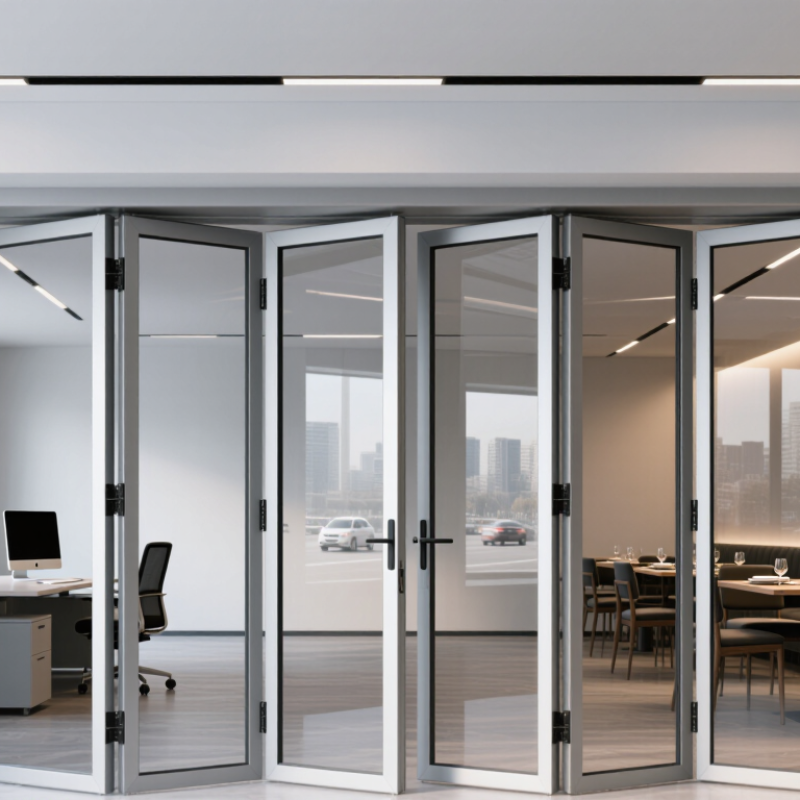
How to Choose Soundproof Aluminum Folding Doors
Define Soundproofing Goals for Aluminum Folding Doors
Start with the noise, not the door. Record the source, time, and room use for several days. Traffic creates low-frequency rumble, while voices and music need stronger speech-frequency control. The World Health Organization’s 2018 Environmental Noise Guidelines recommend indoor bedroom noise below 30 dB(A) at night. Classrooms should remain below 35 dB(A). These figures create practical targets, but they are not automatic door specifications.
Ask what must become quieter. Is the goal privacy, sleep, concentration, or reduced equipment noise? A laboratory STC or Rw value measures transmission under controlled conditions, following methods such as ASTM E90 or ISO 10140. It does not promise the same result on site. A folding door contains several moving joints, panels, rollers, and seals. Small gaps can weaken performance. Door height, threshold design, wall construction, and installation quality matter just as much.
Use a sound meter before choosing the system. Compare the measured level with your target, then discuss the required laboratory rating with a qualified acoustic consultant. Avoid choosing from rating numbers alone. I have seen impressive specifications fail when the meeting rails were poorly adjusted. That mistake is easy to overlook. Recheck the seals after installation, especially around corners and the floor, where daylight often reveals the real problem.

Glass, frame, and seals control different parts of a folding door’s acoustic performance. Glass usually provides the largest sound barrier. Laminated glass adds a flexible interlayer that reduces vibration, while insulated glass units create an extra air cavity. However, thicker glass is not automatically better. The spacing, asymmetry, and interlayer design also matter.
ISO 10140 laboratory testing measures airborne sound insulation, while ISO 717-1 converts results into a rated value. Ask for complete test data, not only a single marketing claim.
Aluminum is strong and slim, but its hollow sections can transmit vibration. Thermally broken profiles may improve comfort, yet they do not guarantee superior soundproofing. Internal chambers, rigid joints, and careful panel alignment matter more. Small gaps can ruin good glass. Really small gaps.
Look for continuous compression gaskets around every panel, meeting stile, and floor track. The U.S. National Institute of Standards and Technology has repeatedly highlighted installation quality as a major factor in building acoustic performance.
The World Health Organization’s 2018 Environmental Noise Guidelines recommend indoor night noise below 30 dB(A) for good sleep.
A laboratory rating may not deliver that result beside a poorly sealed threshold. Check corner compression, brush seals, drainage paths, and hardware adjustment after installation. I would not trust a high acoustic rating without edge details and field evidence.
Choosing a soundproof aluminum folding door starts with accurate opening measurements. Measure the width at the top, center, and floor level. Record the smallest width. Measure the height on both sides and in the middle. Uneven readings may indicate a sloping floor or a shifted frame.
Measure diagonally from corner to corner. The two diagonal measurements should be nearly equal. Check whether the jambs are plumb and the head is level. Small errors matter. I have seen a few millimeters of misalignment create uneven seals and difficult panel movement. A steel tape, laser level, and written record can prevent expensive adjustments.
Installation requirements need equal attention. Confirm the finished floor height before selecting the threshold. Check whether the ceiling or header can support the upper track and its operating load. Leave enough space for stacked panels, handles, and maintenance access. Inspect the wall structure, especially when fixing the track to plasterboard or masonry. Sound control also depends on continuous gaskets, tight corners, and a properly sealed threshold. Ask the installer for the required clearances and fixing points in writing. Some installations need reinforcement that is easy to overlook. I have also found that drawings can miss skirting boards, radiators, or nearby switches. Mark these obstacles on site before ordering. A final site check is wise, even when the original measurements look perfect.
How to Choose Soundproof Aluminum Folding Doors
Door hardware often determines whether an acoustic system performs well after installation. Check hinges, rollers, latches, and compression seals for smooth, consistent movement. A weak latch may leave a small gap along the meeting stile. That gap matters.
Look for seals that close against the frame without crushing or twisting. Drop seals can reduce sound leakage beneath each panel, especially on hard floors. However, they need a flat threshold and accurate alignment. Magnetic seals may improve closure, but they are not a substitute for proper adjustment. During inspection, open and close the door repeatedly. Listen for scraping, rattling, or uneven contact. Small defects become obvious in quiet rooms.
Panel construction also deserves careful attention. Heavier panels usually resist airborne sound better than lightweight hollow sections. A dense insulated core, strong perimeter frame, and limited glass area can improve overall performance. Yet panel weight affects hinges, rollers, and floor loading. The acoustic rating should match the complete tested assembly, not only the panel material. Review STC or Rw values, test conditions, and frequency data. Field results are often lower because of imperfect walls, thresholds, and installation gaps. A high rating can still disappoint. I would also question unusually impressive claims without a complete test report. Soundproofing is rarely perfect, and folding joints remain vulnerable points. Be realistic about traffic noise, voices, and low-frequency sound.
| Category | Evaluation Dimension | Typical or Target Data | What to Check Before Purchase | Priority |
|---|---|---|---|---|
| Acoustic Rating | STC rating of the complete door assembly | STC 30–35: basic speech reduction; STC 36–40: improved privacy; STC 41–45: strong acoustic performance for many residential and commercial applications. | Request a laboratory test report for the complete folding-door assembly, including panels, seals, frame, hardware, and installation method. Do not rely only on the rating of the glass or panel core. | High |
| Acoustic Rating | Test standard and report validity | The report should identify the test method, specimen construction, dimensions, frequency range, and measured rating. ASTM E90 and ASTM E413 are commonly referenced in North American specifications. | Confirm that the tested configuration matches the proposed door, including the number of panels, glass type, frame profile, threshold, seals, and operating direction. | High |
| Panels | Panel construction and mass | Heavier, thicker, and multi-layer panels generally provide better airborne sound reduction than lightweight single-layer panels. A resilient or airtight core can improve performance. | Check panel thickness, surface material, core composition, internal voids, and whether the construction is solid, laminated, or insulated. Ask for panel weight per square metre where available. | High |
| Panels | Glass configuration | Laminated acoustic glass usually performs better than monolithic glass of the same general thickness. Different glass thicknesses in an insulated unit can reduce coincident-frequency weaknesses. | Verify glass thickness, laminate type, air-space width, gas fill if specified, spacer type, and whether the acoustic value applies to the complete door rather than glass alone. | High |
| Panels | Panel-to-panel joints | Continuous interlocking or overlapping seals are preferable to open butt joints because sound can pass through even small discontinuities. | Look for compression gaskets, magnetic seals, interlocking stiles, and consistent contact along the full vertical joint when the doors are closed. | High |
| Seals and Gaps | Perimeter compression seals | A continuous, replaceable gasket around the head, jambs, and meeting stiles is essential for maintaining an airtight sound barrier. | Check gasket material, compression requirements, corner continuity, UV resistance, replacement availability, and whether the seal remains compressed after repeated operation. | High |
| Seals and Gaps | Bottom seal and threshold | A compression drop seal or properly sealed threshold can significantly reduce the leakage path at the floor. An unsealed bottom gap can compromise the whole assembly. | Confirm the drop seal engages evenly, the floor is sufficiently level, drainage requirements are addressed, and accessibility or weather-barrier requirements are still satisfied. | High |
| Door Hardware | Hinges and pivot hardware | Hardware must support the actual panel weight and the specified operating cycle. Misalignment can create gaps and reduce acoustic performance. | Compare the rated load with the panel weight, review cycle testing, confirm corrosion resistance, and check whether hinges or pivots can be adjusted after installation. | High |
| Door Hardware | Locking and compression points | Multiple locking points or compression latches can maintain uniform gasket pressure across tall or wide folding-door leaves. | Check the number and location of locking points, handle operation, latch engagement, adjustment range, and whether the locking system pulls the panels tightly into the seals. | High |
| Door Hardware | Top-hung or bottom-rolling system | Top-hung systems can reduce floor-track interruptions, while bottom-rolling systems may carry substantial loads at the floor. Acoustic performance depends on the complete sealed design, not the suspension type alone. | Evaluate structural support, track deflection, rolling noise, maintenance access, floor conditions, and whether the selected system permits consistent gasket compression. | Medium |
| Aluminum Frame | Thermal break and profile design | Thermally broken aluminum profiles reduce conductive heat transfer. They may also provide more space for gaskets, but a thermal break by itself is not an acoustic rating. | Review profile depth, thermal-break location, frame chambers, gasket seats, drainage paths, and the tested acoustic performance of the actual profile system. | Medium |
| Installation | Opening preparation and frame anchoring | A rigid, square, and properly supported opening is necessary to keep panel alignment and seal compression consistent. | Confirm allowable tolerances, structural header requirements, anchor spacing, shimming method, perimeter backer materials, and the specified acoustic sealant. | High |
| Installation | Perimeter air sealing | Continuous low-leakage sealing at the frame-to-wall interface prevents flanking paths that can bypass the door leaf. | Specify compatible acoustic sealant or gasket systems and require sealing at corners, joints, fasteners, and transitions to adjacent walls or glazing. | High |
| Usability | Opening size and panel arrangement | More panels create more vertical joints and potential leakage paths. Fewer, wider panels may reduce joints but can increase panel weight and hardware loads. | Balance clear opening, stacking direction, panel width, panel weight, traffic flow, escape requirements, and the number of inter-panel seals. | Medium |
| Durability | Operating-cycle and maintenance data | A durable system should provide documented cycle-test information and a maintenance schedule for rollers, hinges, locks, gaskets, and adjustment points. | Ask for cycle-test results, replacement-part availability, lubrication requirements, gasket service life, adjustment procedures, and cleaning limitations for aluminum and glass. | Medium |
| Acoustic Design | Room-side flanking transmission | Sound can bypass a high-rated door through adjacent walls, ceilings, floors, ducts, and connected glazing. The installed result may therefore be lower than the laboratory rating. | Assess the surrounding wall and ceiling construction, use compatible acoustic partitions, seal service penetrations, and avoid treating the door as an isolated component. | High |
Note: Acoustic performance is system-dependent. STC values, air-leakage results, structural limits, and operating-cycle data should be verified against current test reports and the exact door configuration being specified.
Choosing a soundproof aluminum folding door starts with the supplier, not the finish. Ask for laboratory test reports based on ASTM E90 and ASTM E413. These standards measure sound transmission and support comparable STC ratings. A high panel rating can still disappoint when air leaks around the frame. That detail is easy to miss.
The World Health Organization’s Environmental Noise Guidelines for the European Region recommend indoor bedroom noise below 30 dB(A) at night. This is a useful comfort benchmark, not a guaranteed door result. Request the complete tested assembly, including glass, seals, tracks, hinges, and locking points. Confirm whether testing used the same panel size and configuration. Small differences matter.
Maintenance planning should be written into the quotation. Ask how often rollers, brushes, gaskets, and locks require inspection. Request replacement-part availability for at least ten years. The supplier should explain cleaning methods, drainage paths, corrosion protection, and adjustment procedures. A 2023 building performance report from the U.S. Department of Energy stresses that air sealing strongly affects acoustic and energy performance. Your installer should inspect junctions with a smoke pencil or similar method. It is practical evidence.
Do not trust perfect claims.
Real buildings are imperfect. Door movement, dust, and worn seals can reduce performance. A qualified supplier admits these limits and provides service records, response times, and clear warranty exclusions.
Get in Touch
570 Alden Road Unit #10, Markham Ontario Canada, L3R 8N5
Quick Links
Featured Products
Industries