Choosing the right Deep Boring Machine in 2026 requires more than comparing catalog prices. It demands attention to hole diameter, boring depth, material hardness, accuracy, and production volume. A machine used for hydraulic cylinders differs greatly from one designed for automotive shafts or large steel components.
This guide introduces major deep boring machine types, including gun drilling machines, BTA boring systems, trepanning machines, and CNC deep hole boring centers. Each design has different strengths, operating limits, tooling requirements, and maintenance needs. In practical workshops, spindle stability and coolant filtration often influence results more than advertised power ratings. Accuracy comes first.
Pricing can vary widely. Machine size, automation, CNC functions, brand reputation, tooling packages, and after-sales support all affect the final quotation. New entry-level equipment may suit smaller manufacturers, while advanced multi-axis systems can require a much larger investment. Used machines may reduce upfront costs, but their guideways, spindle bearings, hydraulic systems, and control units need careful inspection.
No price table is perfectly permanent. Supplier location, shipping costs, installation, training, and local taxes can change the real budget. That limitation matters. Reliable purchasing decisions should compare technical specifications, sample machining results, warranty terms, and documented customer experience. The figures discussed in this article should therefore serve as planning references, not guaranteed offers. Readers should confirm current details directly with qualified manufacturers and evaluate whether each machine matches their materials, tolerances, floor space, and expected workload.
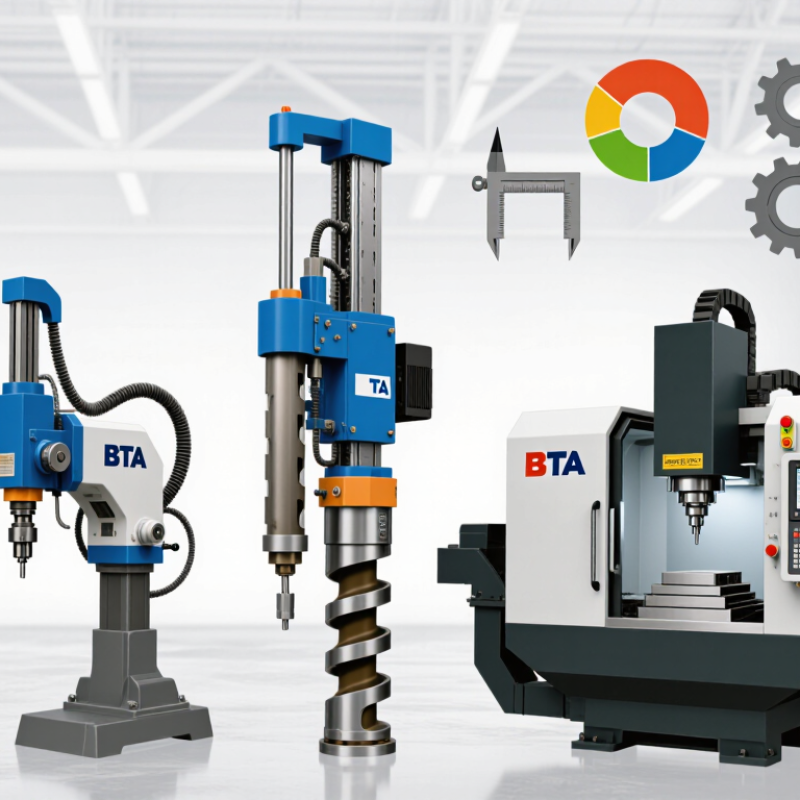
Deep boring machines create long, accurate holes in shafts, hydraulic cylinders, molds, and energy components. Their practical range often begins near 30 mm and extends beyond 200 mm. The required bore diameter is only one decision. Hole depth, length-to-diameter ratio, workpiece weight, and surface finish also influence machine selection.
Machines for 30–60 mm bores usually suit smaller shafts and cylinder parts. Gun boring or single-tube systems can control chips through narrow passages. For 60–120 mm holes, BTA-style equipment offers stronger coolant flow and efficient chip removal. Larger 120–200 mm bores often require heavier beds, steadier workholding, and more powerful drives. Production data matters here. The 2024 World Machine Tool Survey from Gardner Intelligence links advanced metal-cutting demand with automation and higher-value manufacturing. That trend supports investment in digital monitoring, though the report does not isolate deep boring machines.
The U.S. Department of Energy’s Industrial Decarbonization Roadmap also highlights machining energy use and process efficiency. High-pressure coolant, shorter setup times, and fewer rejected parts can reduce operating waste. In practice, a 30 mm bore may need delicate alignment, while a 200 mm bore demands structural stability. Price varies widely with spindle power, travel length, automation, and inspection systems. Published market estimates are often inconsistent. Buyers should request cycle-time trials and accuracy records before trusting a quotation. Not every larger machine performs better.

In 2026, deep-Hole Boring Machines are selected by hole depth, diameter, workpiece weight, and required accuracy. Horizontal machines remain practical for long shafts, hydraulic cylinders, and tubular parts. The workpiece rotates while the boring bar advances through its length. Typical prices range from $80,000 to $300,000, depending on spindle power, tooling, and automation.
Vertical deep boring machines suit heavy, short, or wide components that are difficult to support horizontally. Their upright layout can reduce floor-space pressure and improve chip removal on certain jobs. Prices often start near $120,000 and may exceed $450,000 for large-capacity systems. Operators should inspect table load ratings carefully. A low price can hide expensive fixture requirements.
CNC deep-hole boring machines provide programmed feeds, repeatable positioning, and better control over complex bore profiles. They are valuable when production includes changing dimensions or tight tolerances. Entry-level CNC equipment may cost $180,000 to $350,000, while advanced configurations can pass $700,000. Actual quotations vary by region, installation, training, and inspection equipment. In field evaluations, coolant filtration and boring-bar stiffness often affect results more than advertised speed. That detail is easy to miss. Buyers should compare complete operating costs, not only the machine invoice. Even experienced teams can underestimate setup time when switching between large and small workpieces.
Typical new-machine purchase price estimates by deep-hole boring machine type.
The chart uses the midpoint of each typical 2026 new-machine price range. Actual prices vary according to bore diameter, maximum depth, spindle power, automation, workpiece capacity, tooling, installation, freight, and taxes. Prices are shown in U.S. dollars and exclude auxiliary equipment.
2026 Top Deep Boring Machine Types and Prices
In 2026, deep boring machine prices generally range from $50,000 to $500,000. Compact gun drilling machines usually cost $50,000–$120,000. They suit holes below 80 mm and moderate production volumes. Medium horizontal deep boring machines often sell for $120,000–$280,000. Their capacity may reach 150–250 mm, depending on spindle power and workpiece length. Large systems can exceed $300,000 and approach $500,000. They handle long shafts, heavy molds, and diameters above 250 mm.
Capacity is only part of the price. A 6-meter bed, automatic tool changing, high-pressure coolant, and chip filtration can add tens of thousands of dollars. A machine with 30 kW spindle power may cost far more than a similar-looking unit with 15 kW. Installation, foundation work, operator training, and tooling may add 10%–20% to the purchase budget. These costs are often missed.
A practical quotation should state maximum boring depth, diameter tolerance, surface finish, and cycle time. Ask for test-cut records using comparable steel. I have seen buyers compare spindle prices while ignoring coolant recovery equipment. That mistake can distort the real budget. Used machines may fit below $100,000, but control upgrades and worn guideways require careful inspection. The price guide is useful, not perfect. Actual offers still depend on capacity, automation, tooling, delivery, and local service.
In 2026, deep boring machine selection depends less on headline price than on hole geometry. Horizontal gun drilling machines suit small, precise passages in hardened steel. BTA systems handle larger diameters and high-volume chip removal. Trepanning machines reduce material waste in oversized holes.
The key measure is L/D ratio, not table size. A 100:1 ratio is demanding.
A 20 mm hole, 2,000 mm deep, already reaches 100:1. At this depth, bar stiffness, coolant pressure, spindle runout, and tool guidance directly affect accuracy.
Well-adjusted equipment can approach ±0.02 mm, but this figure needs careful qualification.
It may describe diameter variation under controlled material and temperature conditions. It does not guarantee every batch.
Shop-floor trials should verify a sample bore with calibrated gauges.
Indicative 2026 prices range from $80,000 to $250,000 for standard deep-hole systems. Automated configurations can exceed $400,000. Used machines cost less, but control wear and alignment history matter.
A neglected guide pad can erase advertised accuracy quickly. That is an uncomfortable purchasing detail.
Buyers should request test-boring data, L/D limits, tolerance records, service response times, and maintenance logs.
Some quotations omit tooling, coolant filtration, installation, and operator training. Those omissions change the real price.
Choosing a deep boring machine starts with the finished hole, not the machine’s advertised horsepower. Match the boring diameter to the workpiece, then allow 15–20% capacity for tooling and future jobs. A 40 mm bore through a 1,200 mm shaft needs different rigidity from a 300 mm bore in a short casting. Depth-to-diameter ratio matters. Long, narrow holes demand steady support, controlled chip removal, and accurate coolant delivery.
Production volume changes the decision. Manual or semi-automatic machines can suit repair work and irregular batches, with typical prices often ranging from $30,000 to $120,000. CNC deep boring systems may exceed $150,000 and can pass $500,000 with automation, probing, filtration, and special tooling. These figures are practical market ranges, not quotations. Regional installation and training costs can alter them sharply. The International Federation of Robotics reported 541,302 industrial robots installed worldwide in 2023, showing how quickly automated production is expanding. Yet automation is not automatically economical.
Cycle time must justify it. A high-output cell benefits from automatic loading, tool monitoring, and in-process measurement. A low-volume workshop may gain more from flexible fixturing and simpler controls. The International Energy Agency continues to identify industrial efficiency as a major manufacturing priority, so coolant pumps, motors, and idle-time consumption deserve attention. I have seen selection sheets ignore chip evacuation until the first long bore overheats. That mistake is expensive. Recheck the material, tolerance, operator skill, floor space, and maintenance access before comparing final prices.
Indicative 2026 new-machine price ranges in USD. Actual pricing varies with spindle power, workholding, tooling, coolant filtration, automation, accuracy requirements, installation, and regional taxes.
| Machine Type | Typical Bore Diameter | Typical Boring Depth | Workpiece Capacity | Automation Level | Typical Output Profile | Indicative 2026 Price Range | Best Application | Key Selection Consideration |
|---|---|---|---|---|---|---|---|---|
| Single-Spindle CNC Deep Hole Boring Machine | 20–250 mm | 500–3,000 mm | Small to medium cylindrical parts; workpieces commonly up to 3,000 kg | Medium to high; CNC feed, programmable cycles, optional automatic tool measurement | Flexible batch production with consistent bore diameter and straightness | US$90,000–220,000 | General engineering, hydraulic cylinders, shafts, molds, and energy components | Match spindle torque and guide-bushing design to the required bore-to-depth ratio |
| Twin-Spindle CNC Deep Hole Boring Machine | 20–180 mm per spindle | 500–2,500 mm | Small to medium workpieces; parallel production of similar or different parts | High; dual-spindle synchronization and programmable loading options | Higher throughput than a single-spindle machine when two bores can run simultaneously | US$160,000–360,000 | Medium- to high-volume production of cylinders, sleeves, and precision tubular parts | Best value depends on sustained utilization; floor space and coolant capacity must support both spindles |
| Gun Drilling Machine | 2–40 mm | Up to approximately 1,500 mm, depending on diameter and tooling | Small to medium components, mold plates, dies, and precision shafts | Medium to high; CNC feed control with automatic cycle monitoring available | High accuracy and excellent straightness for small-diameter deep holes | US$55,000–180,000 | Molds, dies, medical components, fuel-system parts, and precision cooling channels | Choose high-pressure filtration and suitable gun-drill support for long, small-diameter holes |
| BTA Deep Hole Drilling and Boring Machine | 50–1,000 mm | 1,000–12,000 mm | Large and heavy workpieces; capacity may exceed 20,000 kg on heavy-duty configurations | Medium to high; CNC feed, automatic chip removal, and programmable boring cycles | High metal-removal rate for large-diameter holes and long production runs | US$280,000–900,000+ | Oil and gas components, large hydraulic cylinders, turbine parts, and heavy industrial shafts | Requires substantial coolant flow, chip evacuation, foundation strength, and adequate loading equipment |
| Horizontal Deep Hole Boring Machine | 40–600 mm | 800–8,000 mm | Long shafts, cylinders, tubes, and irregular heavy parts | Medium; CNC axis control with optional automatic steady rests and tool changes | Versatile production for long workpieces with good access for loading and inspection | US$180,000–650,000 | General heavy machining, hydraulic equipment, construction machinery, and long tubular parts | Verify maximum workpiece length, support spacing, spindle travel, and part deflection control |
| Vertical Deep Hole Boring Machine | 50–800 mm | 500–6,000 mm | Large-diameter parts, castings, dies, and components that are difficult to support horizontally | Medium to high; CNC positioning with automated workholding available | Stable machining of heavy parts with reduced risk of long-part sagging | US$220,000–750,000 | Large molds, pressure-vessel components, valve bodies, and heavy castings | Check maximum part diameter, table load, machine height, and chip removal from vertical bores |
| CNC Trepanning and Core-Boring Machine | 100–1,500 mm | 500–6,000 mm | Large tubular parts and oversized forgings or castings | Medium; CNC feed and programmable radial tool adjustment | Efficient removal of an annular core with lower material waste than full-area boring | US$300,000–1,000,000+ | Large tubes, heavy rings, pressure equipment, and oversized industrial components | Confirm core diameter, maximum wall thickness, cutting-tool availability, and chip-breaker performance |
| Deep Hole Honing and Boring Combination Machine | 25–500 mm | 500–5,000 mm | Precision cylinders, sleeves, barrels, and finished tubular components | High; CNC boring and honing cycles with in-process measurement options | Combines material removal and surface finishing to reduce secondary operations | US$250,000–800,000 | Hydraulic cylinders, shock absorbers, firearm barrels, and precision sleeves | Prioritize required roundness, cylindricity, surface roughness, and measurement repeatability |
| Multi-Axis Deep Hole Machining Center | 10–250 mm | 300–3,000 mm | Complex prismatic or rotational parts with multiple angled holes | Very high; CNC multi-axis interpolation, probing, tool management, and pallet options | High mix, low-to-medium volume production with reduced re-fixturing | US$350,000–1,200,000+ | Aerospace structures, complex molds, manifolds, and high-value engineered parts | Evaluate axis travel, tool-change time, post-processing capability, and collision-control software |
| Automated Deep Boring Production Cell | 20–300 mm | 500–3,500 mm | Repeatable medium-sized parts with standardized loading interfaces | Very high; robotic loading, automatic gauging, tool-life monitoring, and production data capture | High-volume, low-touch production with reduced operator intervention | US$450,000–1,500,000+ | Automotive, hydraulic, industrial-cylinder, and other repetitive production programs | Calculate total cell return using cycle time, annual volume, labor availability, uptime, and changeover time |
Get in Touch
570 Alden Road Unit #10, Markham Ontario Canada, L3R 8N5
Quick Links
Featured Products
Industries